
Summer Snow
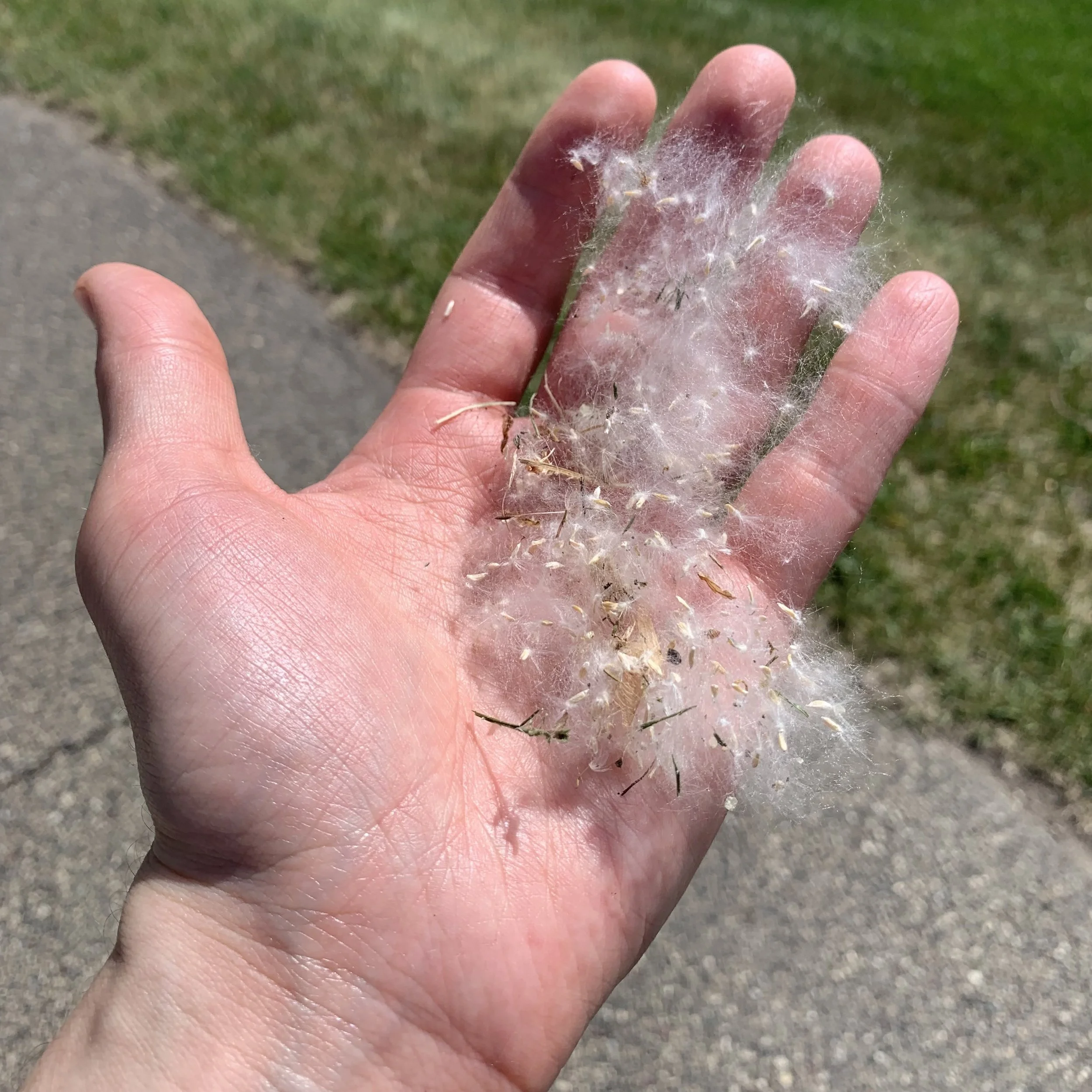
By June, most Americans have bid farewell to winter and are looking forward to warmer days and milder nights. Snow is no longer in the forecast — at least not the icy, wet stuff of January and February. As it turns out, June can have snow showers of a different sort —especially if a cottonwood tree grows nearby.
Cottonwood trees are in the genus Populus. These hardy trees have a wide distribution, growing from Southern Quebec down to Central Texas and Northwest regions of Florida and Georgia. They thrive in sandy or loamy soil and are most often found along riverbanks and streams.
Unlike other plants, cottonwoods are dioecious, meaning that the male and female flowers are produced on separate plants. As early as February or April, depending on location, the male trees produce small, reddish flowers and begin to release pollen. A few days later, the female trees make their own longer flowers that, if pollinated, will develop into strings of small, peas-sized capsules. Inside these capsules there is a snowstorm.
A mature cottonwood capsule contains 30-60 seeds attached to white, wispy fluff. Wind plucks the cotton from dried capsules and can carry them several hundreds of feet away. On a blustery day, a release of cottonwood seeds can give the impression of thick snowflakes floating in the air. The cotton can even accumulate in thin carpets on newly sprouted lawns. A single tree can produce an estimated 48 million seeds!
While a shower of cottonwood snow may not cause backups on the highway, they can be just as disruptive in other ways. Cottonwood contamination is a major concern for any industry that uses air intake valves, pumps or irrigation, as the accumulating fluff can cause all sorts of blockages. The seeds and fluff are also extremely flammable. A single spark can rapidly ignite a field of fluff in a TikTok-worthy conflagration that lawn-conscious suburbanites use to clear their yards but that has also been linked to destructive wildfires. So just like winter snow, it’s probably best to shovel away the fluff . . . after making a cottonwood angel or two.
Brian Rutter, PhD, is the cofounder of Hundredfold Video and plant biologist working for 2Blades at the University of Minnesota. Subscribe to our newsletter to receive our “Sower Stories – Odd Facts About Plants” and video production tips in your inbox every month!
Works Cited:
Cooper, D. T. “Eastern Cottonwood.” Silvics of North America. U.S. Department of Agriculture, Forest Service. Published December 1, 1990. Accessed June 27, 2026. https://research.fs.usda.gov/silvics/eastern-cottonwood.
NEWS10 ABC. “Hot Temps, Cottonwood Fluff Contributing to Fires.” NEWS10 ABC. Accessed June 27, 2026. https://www.news10.com/news/hot-temps-cottonwood-fluff-contributing-to-fires/. (The article does not appear to have been indexed with readily available author and publication metadata. If you are using this in a formal publication, you may wish to verify the byline and publication date directly on the webpage.)
Thorpe, McKenzie. “Protection from Cottonwood: What You Need To Know.” Schroeder Industries. March 24, 2025. Accessed June 27, 2026. https://schroederindustries.com/protection-from-cottonwood-what-you-need-to-know/.