
Pop!
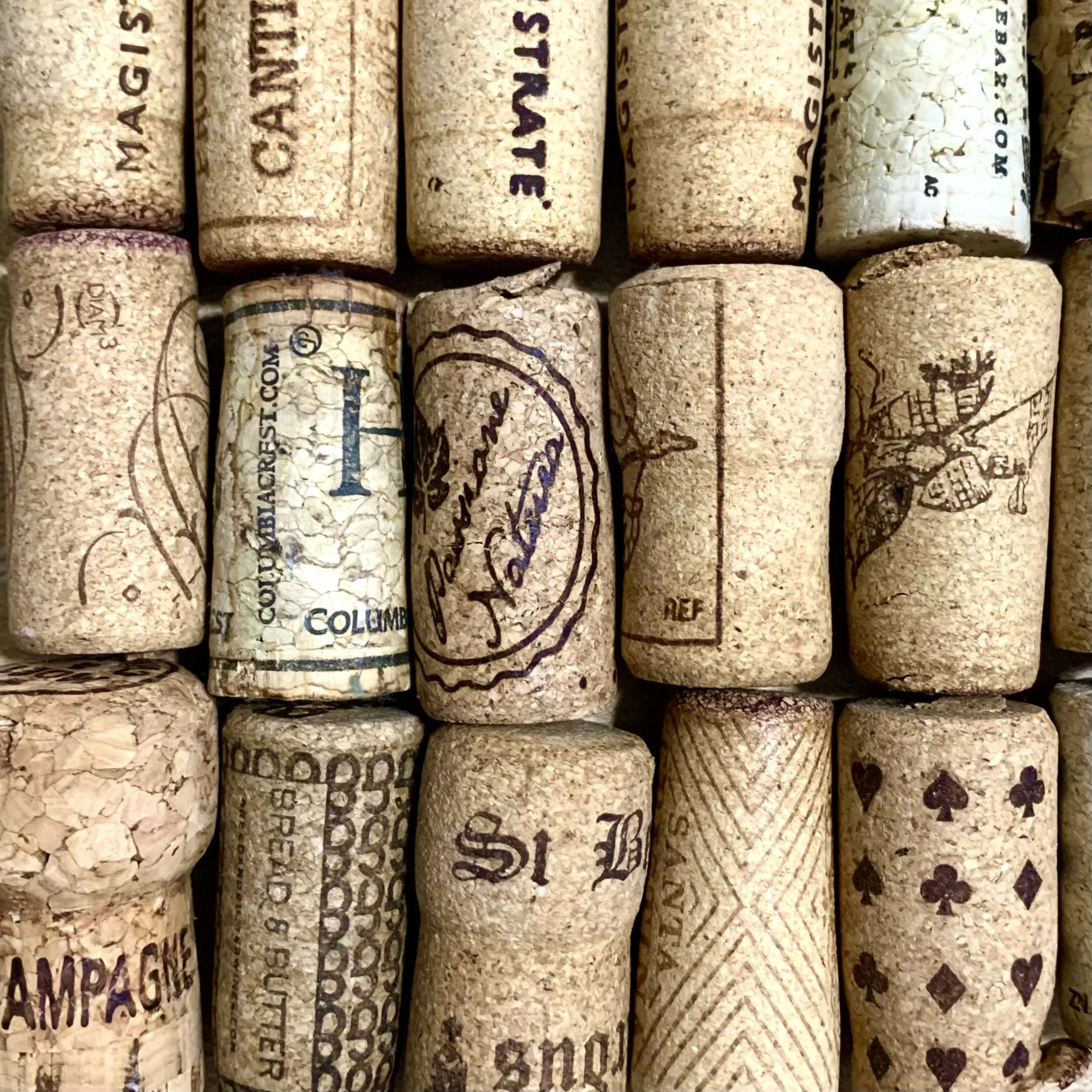
Each New Year’s Eve, millions of champagne bottles worldwide are popped in celebration. A new year almost always begins with a fountain of fizzing bubbles and a volley of flying corks. Between giddy sips and choruses of “Old Lang Syne” it might be worth thinking about corks. Where did all those celebratory projectiles come from?
The corks found sealing a of bottle champagne or wine come from the cork oak (Quercus suber), an evergreen tree native to the Mediterranean. The inner bark of the cork oak, known as phellem, is a thick, protective layer of mostly dead, fortified cells. Every 9-10 years, this layer of bark is removed, washed and boiled before bottle corks are punched or hand-cut out of the material.
The first harvest of bark from a cork oak is known as “virgin cork.” It’s irregular and crumbly and only useful in cork boards, insulation or shoe soles. But fear not; the cork oak continually re-grows its bark, and each new round of growth is better than the last. Nine years after the first harvest, the bark is known as “first reproduction cork.” It’s better than virgin cork, but still not good enough to stopper a bottle. Only after another nine years can a tree make “second reproduction cork,” which is suitable for bottles. So it takes nearly three decades to stopper a bottle of champagne!
There is some mention from 25 B.C. of cork being used to seal a wine bottle, but this application was rare in early history. Cork was more commonly used as floats for fishing nets, buoys for anchor ropes or as soles for shoes. Invention of the bottle cork is credited to Dom. Perignon, a 17th century Benedictine monk who made significant contributions to the production and quality of champagne.
Champagne corks start out cylindrical, but are compressed 60-70% of their original diameter when squeezed into the bottle’s neck, at which point they take on an iconic mushroom shape. Most champagne corks are actually agglomerated corks, made of three different sections: two stacked discs of natural cork at the bottom and a region of glued-together cork granules on top that allows very little oxygen into the bottle.
Most New Year’s revelers would never guess the history, engineering and years of tree growth that all go into a champagne bottle’s . . . pop!
Brian Rutter, PhD, is the cofounder of Hundredfold Video and plant biologist working for 2Blades at the University of Minnesota. Subscribe to our newsletter to receive our “Sower Stories – Odd Facts About Plants” and video production tips in your inbox every month!
Works Cited:
Dupont, Estelle. “The champagne cork: it’s history, design and how to reuse it.” Millesimal-use.com. 5 March 2023. Accessed 18 January 2026. “https://www.millesima-usa.com/blog/the-champagne-cork-its-history-design-and-how-to-reuse-it.html.”
Raubenheimer, Otto. "Cork. Its history, origin and manufacture." Journal of the American Pharmaceutical Association 1, no. 4 (1912): 322-329.
Silva, Susana Pinto, Marcos Antonio Sabino, Emanuel M. Fernandes, Vitor M. Correlo, Luciano F. Boesel, and Rui L. Reis. "Cork: properties, capabilities and applications." International materials reviews 50, no. 6 (2005): 345-365.